Galactic phenomena captivate the imagination and challenge our understanding of the universe. From mesmerizing nebulae to powerful black holes, these cosmic events reveal the intricate workings of space. As scientists delve deeper into the mysteries of the cosmos, they uncover processes that shape galaxies and influence the very fabric of reality.
Exploring these phenomena not only satisfies human curiosity but also enhances our knowledge of physics and astronomy. Each discovery offers a glimpse into the origins of stars, the dynamics of galactic collisions, and the potential for life beyond Earth. As technology advances, researchers are equipped with tools that push the boundaries of what’s known, inviting everyone to marvel at the wonders of the universe.
Overview of Galactic Phenomena
Galactic phenomena encompass a wide range of extraordinary events and structures within galaxies. These phenomena include nebulae, black holes, supernovae, and galactic collisions. Each phenomenon contributes uniquely to the formation, evolution, and dynamics of galaxies.
Nebulae
Nebulae are vast clouds of gas and dust in space. They serve as stellar nurseries where new stars form. Types of nebulae include:
- Emission Nebulae: These emit light due to ionized gas, often showcasing vibrant colors.
- Reflection Nebulae: These reflect light from nearby stars, appearing bluish in hue.
- Dark Nebulae: These obscure light from objects behind them, creating shadowy regions in space.
Black Holes
Black holes are regions of spacetime exhibiting gravitational pull so strong that nothing, not even light, can escape. Types of black holes include:
- Stellar Black Holes: Formed from collapsing massive stars, typically ranging from three to several tens of solar masses.
- Supermassive Black Holes: Found at the centers of galaxies, they can contain millions to billions of solar masses.
- Intermediate Black Holes: These may exist in clusters, with masses falling between stellar and supermassive categories.
Supernovae
Supernovae are powerful explosions marking the end of a star’s life cycle. They occur in two primary types:
- Type I Supernovae: Result from the accumulation of material in a binary star system, leading to a catastrophic collapse.
- Type II Supernovae: Occur when massive stars exhaust their nuclear fuel, causing core collapse.
Galactic Collisions
Galactic collisions happen when two or more galaxies gravitationally interact. These events result in various outcomes:
- Morphological Changes: Collisions can significantly alter the shapes and structures of galaxies.
- Star Formation: Collisions often trigger bursts of star formation due to the compression of gas clouds.
- Formation of Elliptical Galaxies: Mergers can lead to the creation of new elliptical galaxies as stars coalesce.
Understanding these galactic phenomena enhances knowledge of cosmic evolution and the fundamental workings of the universe. Technologies in astrophysics continue to advance, allowing deeper exploration and insight into these monumental events.
Types of Galactic Phenomena
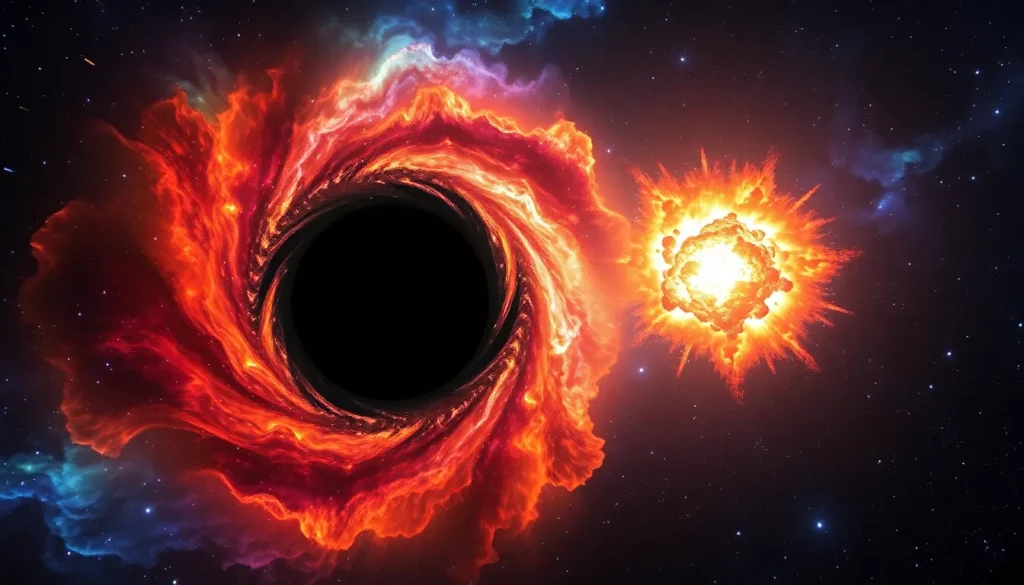
Galactic phenomena encompass various cosmic events that illustrate the complex processes of the universe. Key types include stellar birth and evolution, black holes and neutron stars, as well as supernovae and gamma-ray bursts.
Stellar Birth and Evolution
Stellar birth and evolution occur within nebulae, where regions of gas and dust collapse under gravity. This process forms protostars, which eventually ignite nuclear fusion. Stars progress through distinct stages, including main sequence, red giant, and, finally, either supernova or white dwarf phases. Stellar evolution significantly affects surrounding celestial bodies and contributes to the recycling of materials in the universe.
Black Holes and Neutron Stars
Black holes and neutron stars represent end states in stellar evolution. Black holes emerge from the gravitational collapse of massive stars, creating regions where gravity is so intense that not even light can escape. Neutron stars form from the remnants of supernova explosions, featuring incredibly dense matter primarily composed of neutrons. The study of these objects enhances understanding of gravity, quantum mechanics, and the limits of stellar structure.
Supernovae and Gamma-Ray Bursts
Supernovae and gamma-ray bursts mark explosive events in a star’s life cycle. Supernovae occur when a star exhausts its nuclear fuel, leading to a catastrophic explosion that disperses elements into space, enriching the interstellar medium. Gamma-ray bursts are the most energetic explosions observed, thought to occur during the collapse of massive stars or the merging of neutron stars. Both phenomena provide valuable insights into stellar processes, element synthesis, and the dynamics of the cosmos.
The Role of Dark Matter in Galactic Phenomena
Dark matter plays a critical role in galactic phenomena, influencing galaxy formation and dynamics. Comprising about 27% of the universe’s total mass-energy content, dark matter interacts gravitationally but doesn’t emit, absorb, or reflect light, complicating direct observations.
Gravitational Effects
Gravitational effects from dark matter significantly shape galaxies. Galaxies possess more mass than visible matter can account for, leading to an increased gravitational pull. This unseen mass helps bind galaxies together, facilitating their stability over billions of years. Research indicates that the rotation curves of spiral galaxies suggest far more mass exists than observable stars and gas alone.
Galaxies’ Structure and Formation
The presence of dark matter influences galaxy formation processes. Simulations demonstrate that dark matter halos create gravitational wells that attract normal matter, ultimately forming stars and galaxies. The clustering of dark matter leads to large-scale structures in the universe, including galaxy clusters. Observational studies, such as those conducted with the Hubble Space Telescope, support these findings through the detection of gravitational lensing effects caused by dark matter.
Cosmic Microwave Background
Dark matter also impacts the Cosmic Microwave Background (CMB) radiation. Analyzing fluctuations in the CMB provides insight into the distribution of dark matter in the early universe. Observations indicate that regions with higher dark matter concentrations led to the formation of galaxies and large-scale structures observed today. This relationship highlights the essential connection between dark matter and the universe’s evolution.
Future Research Directions
Future research will focus on understanding dark matter’s properties and its precise role in galactic phenomena. Various experiments, such as direct detection methods and particle collider experiments, aim to shed light on dark matter particles. Advancements in technology and methodologies can significantly enhance our capacity to comprehend dark matter’s influence on galactic formation and dynamics.
Conclusion
Dark matter stands as a cornerstone in the study of galactic phenomena. Its gravitational effects, influence on galaxy structure and formation, and impact on cosmological studies emphasize its fundamental role in shaping the universe. Understanding dark matter continues to be a primary research goal in astronomy and astrophysics, vital for deciphering the mysteries of cosmic evolution.
Observational Techniques in Studying Galactic Phenomena
Various observational techniques play pivotal roles in studying galactic phenomena. Each method offers unique insights, enhancing understanding of galaxies and cosmic events.
Telescopes
- Optical telescopes capture visible light from celestial objects. Ground-based telescopes, such as the Keck Observatory, provide high-resolution images, while space-based telescopes like the Hubble Space Telescope avoid atmospheric distortion.
- Radio telescopes detect radio waves, revealing information about phenomena like pulsars and cosmic microwave background radiation. The Very Large Array (VLA) offers detailed images of galactic structures.
- Infrared telescopes like the Spitzer Space Telescope penetrate dust clouds, allowing observation of star formation in nebulae where optical telescopes may fail.
Spectroscopy
- Spectroscopy analyzes light from distant objects, determining their composition and speed. By analyzing the light spectrum, scientists identify elements, temperatures, and velocities of stars and galaxies.
- Redshift measurements prove crucial for understanding the universe’s expansion. Observing redshifts allows for calculating the distance and velocity of galaxies, providing insights into cosmic evolution.
Computational Simulations
- Computational simulations model galactic phenomena, facilitating predictions and analyses. They simulate scenarios such as galaxy collisions and star formation processes, helping to visualize complex interactions over time.
- Hydrodynamic simulations examine gas dynamics in galaxies, offering insights into how gas accretes and forms stars within galactic disks.
Gravitational Wave Detection
- Gravitational wave detection opens new avenues for studying cosmic events. Instruments like LIGO and Virgo detect ripples in spacetime from events like black hole mergers or neutron star collisions, revealing aspects of stellar evolution previously inaccessible.
Multi-Wavelength Observations
- Multi-wavelength observations integrate data from various regions of the electromagnetic spectrum. This comprehensive approach enhances the understanding of phenomena such as supernovae and gamma-ray bursts, each exhibiting diverse characteristics across different wavelengths.
- X-ray and gamma-ray telescopes reveal high-energy processes, crucial for studying supernova remnants and black hole accretion disks, deepening comprehension of energetic galactic events.
Through these observational techniques, researchers uncover the intricate processes governing galaxies and cosmic phenomena, forging a path for future discoveries in astrophysics.
Recent Discoveries in Galactic Phenomena
Astronomers continue to unveil remarkable discoveries in galactic phenomena. Studies reveal new insights into mysterious dark matter and its effects on galaxy formation. Advanced simulations indicate that dark matter interacts with regular matter, influencing the gravitational architecture of galactic structures.
Recent observations from the James Webb Space Telescope (JWST) enhance comprehension of nebulae, revealing previously unseen details in their intricate formations. For example, JWST data highlights the rich dynamics of star clusters within emission nebulae, providing a clearer view of their formative processes.
Exploration of black holes also advances. Observations confirm the existence of intermediate-mass black holes, bridging gaps in knowledge between stellar and supermassive black holes. These findings contribute to understanding black hole formation pathways across different stellar environments.
Supernovae remain a focal point in research. The discovery of peculiar supernova types, such as superluminous supernovae, challenges existing models of stellar explosions. These events release substantial energy and may contribute to chemical enrichment in the universe, altering theories on the life cycles of stars.
Galactic collisions are gaining attention as well. The merging of two or more galaxies can trigger bursts of star formation, transforming galactic structures dramatically. Recent studies through multi-wavelength observations provide new data on the dynamics involved in such extravagant events.
Moreover, gravitational wave astronomy is revolutionizing the study of cosmic phenomena. Events like black hole mergers are now detected through waves rippling across space-time. Recent detections enhance understanding of the population and formation mechanisms of black holes.
The connection between cosmic rays and supernova explosions also receives focus. New studies indicate supernova remnants serve as accelerators for these high-energy particles, influencing the interstellar medium and cosmic radiation.
Collaborative efforts across various observatories and research institutions continue to enrich the field of galactic phenomena. These collective advancements facilitate profound insights into the universe, unveiling the intricate processes that govern galaxies and their evolution.
Galactic phenomena captivate the imagination and drive scientific inquiry. As researchers delve deeper into the mysteries of the universe, they uncover the intricate processes that shape galaxies and influence cosmic evolution. From the birth of stars in nebulae to the enigmatic nature of black holes and the explosive power of supernovae, each discovery enriches our understanding of reality.
The advancements in observational techniques and technology promise to reveal even more about dark matter and its pivotal role in the cosmos. As new findings emerge, the collaborative efforts across the scientific community continue to illuminate the pathways of exploration. The universe remains a vast frontier, inviting curiosity and inspiring future generations to seek answers among the stars.