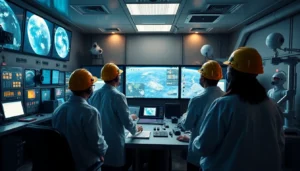
Deep space exploration captivates the imagination and pushes the boundaries of human knowledge. As scientists and engineers work tirelessly to develop advanced technologies, they aim to uncover the mysteries of the universe beyond our solar system. This journey into the unknown not only seeks to answer fundamental questions about existence but also holds the potential for groundbreaking discoveries that could reshape our understanding of life itself.
With missions to distant planets, moons, and beyond, humanity stands on the brink of a new era in space exploration. The quest for extraterrestrial life, the search for habitable environments, and the study of cosmic phenomena drive this ambitious endeavor. As we venture further into the cosmos, the possibilities are as limitless as the stars themselves, inviting curiosity and inspiring generations to come.
Overview of Deep Space Exploration
Deep space exploration encompasses missions that venture beyond Earth’s orbit, focusing on interstellar and intergalactic regions. These missions aim to gather data about celestial bodies and phenomena not influenced by our sun. NASA, ESA, and other space agencies utilize high-tech spacecraft and telescopes to collect valuable information.
Key components of deep space exploration include:
- Telescopes: Ground-based and space-based telescopes, like the Hubble Space Telescope, capture elusive light from distant stars and galaxies. They help scientists analyze light spectra to determine the composition and movement of cosmic objects.
- Robotic Probes: Unmanned spacecraft, such as Voyager and New Horizons, explore and send back data from outer planets and beyond. These probes gather information about solar systems, asteroids, and comets.
- Sample Return Missions: Missions like Osiris-Rex and Hayabusa2 collect material from asteroids and return them to Earth. Studying these samples yields insights into the solar system’s formation and evolution.
- Manned Missions: Initiatives, such as those proposed under NASA’s Artemis program, aim to send astronauts beyond the Moon in future missions. These manned explorations target Mars and other distant destinations.
Deep space exploration seeks answers to profound questions, such as the origins of the universe, the potential for extraterrestrial life, and the fate of celestial phenomena. As exploration efforts progress, humanity’s understanding of existence may broaden, leading to new frontiers in science and technology.
Historical Milestones in Deep Space Exploration
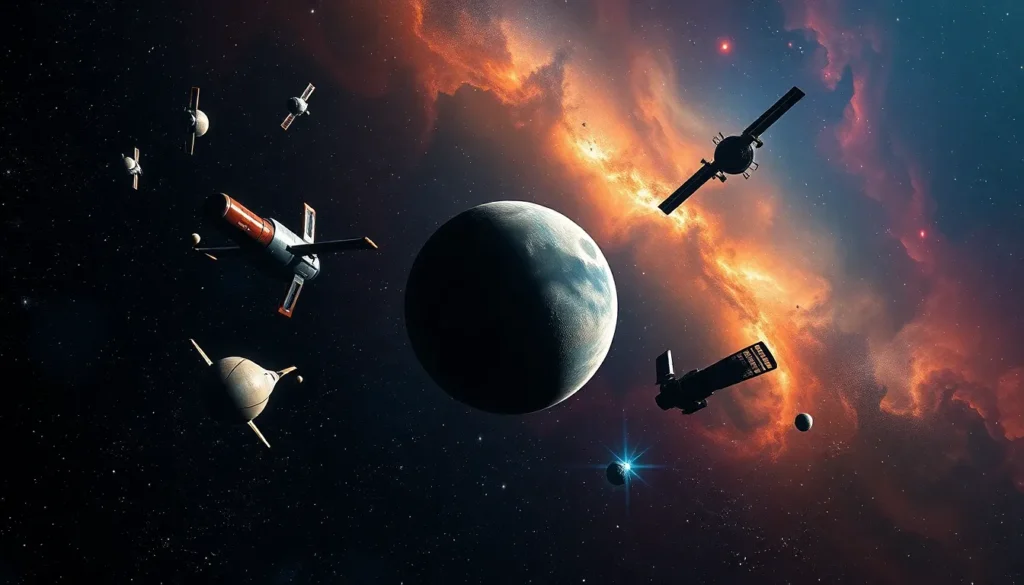
Deep space exploration has a rich history marked by significant missions and discoveries. These milestones redefine humanity’s understanding of the universe and inspire future efforts.
Early Missions
- Pioneer 10: Launched in 1972, Pioneer 10 became the first spacecraft to travel through the asteroid belt and reach Jupiter in 1973, providing crucial data about the gas giant.
- Voyager Program: The Voyager 1 and Voyager 2 missions, launched in 1977, conducted flybys of Jupiter, Saturn, Uranus, and Neptune, transmitting invaluable images and scientific information about these planets and their moons.
- Galileo: This spacecraft, launched in 1989, studied Jupiter and discovered its largest moon, Ganymede, and evidence of water on Europa, expanding knowledge about the potential for life beyond Earth.
Landmark Discoveries
- Discovery of Exoplanets: The Kepler Space Telescope, launched in 2009, identified thousands of exoplanets, many within habitable zones, shifting the focus to the possibility of life elsewhere in the universe.
- Hubble Space Telescope Insights: Launched in 1990, Hubble’s observations led to the detection of dark energy and contributed to the understanding of the universe’s expansion and its age.
- Interstellar Objects: The first known interstellar object, ‘Oumuamua, was detected in 2017, sparking debates about its origin and substance, highlighting the need for deeper exploration beyond the solar system.
Current Missions in Deep Space Exploration
Deep space exploration is marked by several ongoing missions aimed at expanding humanity’s understanding of the universe. These missions focus on various targets, including Mars, asteroids, and interstellar objects, leveraging advanced technology and international cooperation.
NASA’s Artemis Program
NASA’s Artemis program aims to return humans to the Moon by 2024 and establish a sustainable presence by 2028. This program serves as a testbed for technologies and operational practices necessary for future expeditions to Mars and beyond. Artemis I successfully validated the Space Launch System and Orion spacecraft in a mission that orbited the Moon. Artemis II, scheduled for 2024, will carry astronauts on a lunar flyby, further preparing for Artemis III, which targets the lunar South Pole for crewed exploration. These efforts deepen the understanding of lunar geology and prepare for subsequent missions to Mars, focusing on the feasibility of human life on other celestial bodies.
International Collaborations
International collaborations enhance capabilities and resources in deep space exploration. Projects like the James Webb Space Telescope involve partnerships among NASA, the European Space Agency (ESA), and the Canadian Space Agency. This telescope conducts observations of exoplanets, distant galaxies, and cosmic phenomena, providing insights into the universe’s evolution. Additionally, the Lunar Gateway, a joint effort by NASA, ESA, and other space agencies, aims to create a space station in lunar orbit, facilitating deeper exploration and scientific research in the Moon’s vicinity and beyond. Collaborative missions expand the scientific community’s reach and knowledge, paving the way for groundbreaking discoveries.
Future Directions in Deep Space Exploration
Future directions in deep space exploration are driven by technological advancements and the quest for knowledge. Emerging technologies and potential targets play key roles in shaping upcoming missions.
Emerging Technologies
Emerging technologies are transforming deep space exploration, paving the way for innovative missions.
- Ion Propulsion Systems: Ion propulsion systems, which utilize electric fields to accelerate ions, enable longer missions with reduced fuel consumption, showcasing efficiencies not possible with traditional propulsion methods.
- Autonomous Robotic Systems: Autonomous robotic systems, equipped with advanced AI, facilitate real-time decision-making during missions, enhancing data collection and operational efficiency in remote environments.
- 3D Printing: 3D printing technology allows for in-situ resource utilization, enabling spacecraft to manufacture tools and components using local materials, thus reducing the need for extensive resupply missions from Earth.
- Advanced Communication Systems: Advanced communication systems, utilizing laser transmission and enhanced antennas, improve data transfer rates over vast distances, ensuring timely relay of critical information back to Earth.
Potential Targets for Exploration
Potential targets for exploration include a variety of celestial objects that offer unique opportunities to expand human knowledge.
- Mars: Mars remains a primary target due to evidence of past water and current ice, making it vital for studying the planet’s potential for life and future human colonization efforts.
- Europa: Europa, one of Jupiter’s moons, hosts a subsurface ocean beneath its icy crust, creating tantalizing prospects for extraterrestrial life.
- Enceladus: Enceladus, another moon of Saturn, features geysers that eject water vapor and organic molecules, providing insight into the moon’s habitability conditions.
- Asteroids: Near-Earth asteroids represent significant targets for resource extraction and understanding the solar system’s formation, with missions like NASA’s OSIRIS-REx providing impactful data.
- Exoplanets: Exoplanets, particularly those in the habitable zone, are prime candidates for studying a diversity of environments and the potential for life beyond Earth, motivated by ongoing observations from powerful telescopes like the James Webb Space Telescope.
Developing these technologies and targeting these celestial bodies ensures a productive future in deep space exploration.
Challenges Facing Deep Space Exploration
Deep space exploration presents numerous challenges, encompassing technical, logistical, and ethical dimensions that researchers and space agencies must navigate to achieve successful missions.
Technical and Logistical Hurdles
Technical challenges include developing and maintaining spacecraft capable of enduring harsh conditions, long distances, and extended mission durations. Spacecraft must withstand radiation, micrometeoroid impacts, and extreme temperatures, which necessitate advanced materials and engineering solutions. Propulsion systems, such as ion propulsion and nuclear thermal engines, enhance efficiency but require substantial research and validation.
Logistical hurdles present additional complexities. Coordinating international collaboration often involves multiple agencies, diverse regulations, and varied funding mechanisms. Communication delays increase with distance, impacting real-time operations and decision-making. Sample return missions necessitate precise landing and retrieval technologies to ensure successful transport of extraterrestrial materials back to Earth.
Ethical Considerations
Ethical considerations arise from the implications of deep space exploration on extraterrestrial environments. Planetary protection guidelines aim to prevent biological contamination, safeguarding both Earth and other celestial bodies. Oversight ensures that missions do not compromise potential ecosystems or alter the natural state of other planets.
Moreover, the ethical implications of resource exploitation, such as mining asteroids, require ongoing dialogue among stakeholders. Decisions on how to utilize extraterrestrial resources, if proven viable, must weigh potential benefits against environmental impacts and preservation of space heritage. Establishing frameworks for responsible exploration fosters international cooperation and handles these emerging ethical dilemmas.
Deep space exploration represents humanity’s bold quest to understand the universe and our place within it. As missions evolve and technology advances, the potential for groundbreaking discoveries grows exponentially. The collaboration between nations and the integration of innovative technologies will pave the way for future explorations.
With each mission, scientists inch closer to answering profound questions about life beyond Earth and the origins of the cosmos. The challenges faced in this endeavor will require not only technical ingenuity but also ethical considerations to ensure responsible exploration. As humanity reaches for the stars, the journey promises to inspire generations and expand the horizons of knowledge.